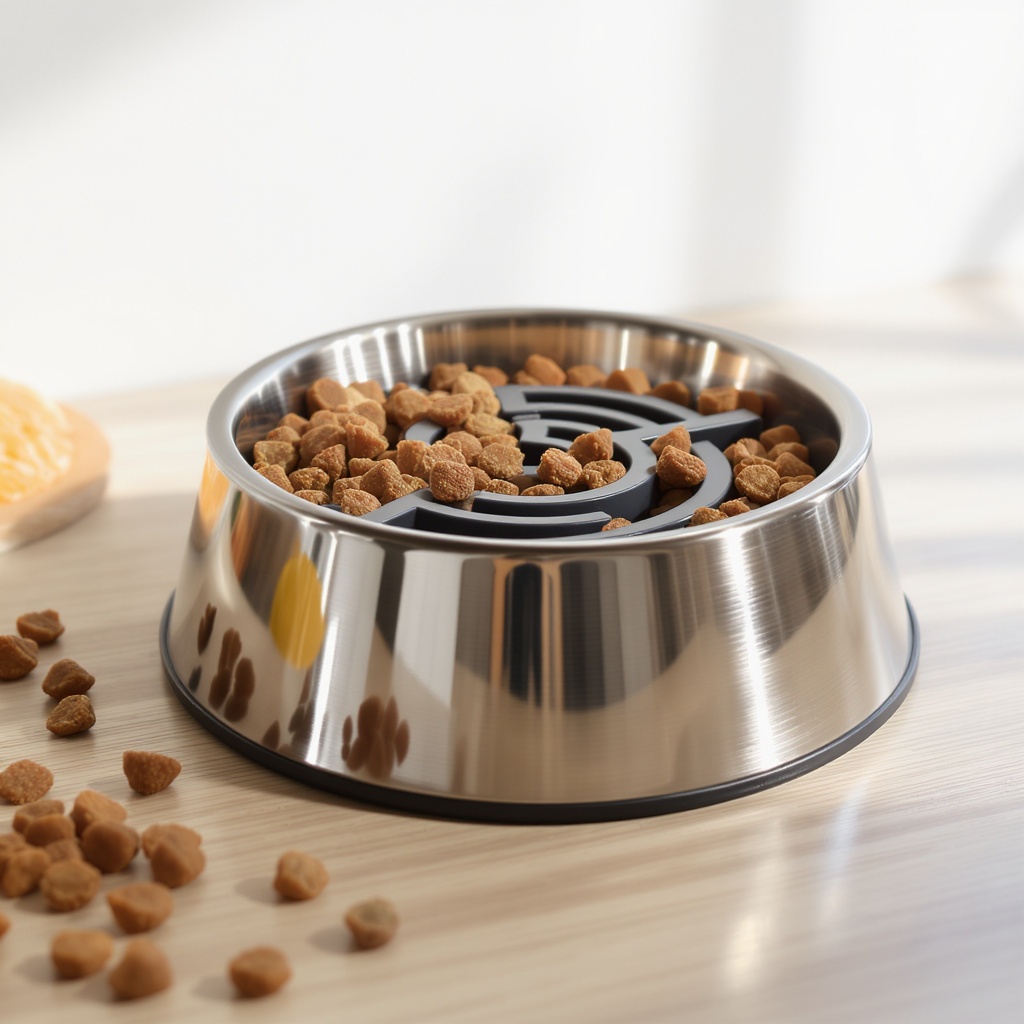
Your dog inhales a full bowl in 45 seconds. You've heard slow feeders help. But do they actually work — or is it marketing? The answer is nuanced: slow feeders reliably slow eating for most dogs, which reduces air swallowing (a primary GDV/bloat trigger) and cuts regurgitation episodes significantly. But no bowl prevents bloat entirely, and some designs cause frustration or cleaning headaches. This guide covers what the research says, what breeds benefit most, and how to pick the right one.
How Fast Eating Causes Problems
When a dog eats rapidly, they swallow air alongside their food. This is called aerophagia — and it's the primary mechanism by which fast eating contributes to bloat (gastric dilatation-volvulus, or GDV). A stomach filled with food and air is more susceptible to twisting, particularly in deep-chested breeds where the stomach has more room to rotate.
Beyond the GDV risk, fast eating causes regurgitation and vomiting after meals — the dog brings up food that was eaten too quickly to digest properly. This is uncomfortable and can lead to aspiration if it happens while lying down.
From a weight management perspective, dogs that eat at speed often consume more than they register as satisfying. It takes roughly 10–15 minutes for satiety signals to reach the brain; a dog that finishes in 45 seconds has no opportunity to feel full before the bowl is empty. Slow feeding extends the meal to a duration closer to that satiety window.
What the Research Says
Multiple veterinary behavior studies show measurable reductions in fast-eating behaviors when slow feeders are introduced. In controlled settings, dogs using maze-style slow feeders showed up to 70% fewer regurgitation episodes compared to eating from a standard bowl.
For deep-chested breeds, the GDV risk reduction is documented but less absolute. Large, deep-chested dogs like German Shepherds, Great Danes, and Standard Poodles have a documented 20% lifetime bloat risk — one of the highest of any breed. Slow feeders reduce air intake, a primary GDV trigger, which measurably lowers the probability. However: no bowl prevents bloat entirely. For high-risk breeds, a slow feeder should be combined with twice-daily feedings (rather than one large meal) and a conversation with your vet about gastropexy surgery — a procedure that partially welds the stomach to the abdominal wall, preventing twisting.
Bloat Risk by Breed
The breeds with the highest documented GDV incidence are deep-chested, large dogs:
Any dog can develop bloat — fast eaters of any breed or size have elevated risk regardless of chest conformation. A 20 lb Beagle that inhales food has a meaningfully higher risk than a 20 lb Beagle that slow-feeds.
What to Look for in a Slow Feeder Bowl
Maze depth is the primary variable in how much a bowl slows eating. Deeper mazes force the dog to navigate more turns and work around more obstacles, extending the meal duration. However, very deep mazes can frustrate flat-faced (brachycephalic) breeds — Bulldogs, Pugs, French Bulldogs — whose shortened snouts make it physically difficult to reach food in deep channels. For brachycephalic breeds, look for shallow-maze or "anti-choke" designs with wider channels.
Material matters. 18/8 stainless steel is the best option: it's durable, dishwasher-safe, non-porous (won't absorb odors or harbor bacteria), and won't crack if a power chewer gets aggressive. BPA-free plastic is acceptable for light chewers but will absorb odors over time and may contain low-quality plastic if sourced cheaply. Avoid any bowl that lists "food-grade plastic" without specifying BPA-free — the category is too broad.
Size match matters. The maze channels should be wide enough for your dog's snout to navigate comfortably without frustration. Too deep for a small dog means they give up and you end up with wasted food and a frustrated pet. Too shallow for a large dog means they just push food over the obstacles.
Non-slip base is essential. Lightweight bowls flip across the floor when a large dog noses into them. A rubberized base or silicone non-slip ring keeps the bowl in place. Stainless steel bowls with a silicone non-slip base are the most stable option.
Dishwasher-safe is non-negotiable for practical reasons: maze designs with narrow channels trap food in nooks that are impossible to clean by hand. If you can't put it through a dishwasher cycle and get it fully clean, it's the wrong bowl.
What to Avoid
Elevated slow-feeder bowls. This is the most important avoidance category. Elevated feeders may actually increase GDV risk in deep-chested breeds because raising the bowl changes the stomach's position in a way that can facilitate twisting. Keep all slow feeders at floor level. The risk-reducing benefit of slow feeding is undermined by the risk-increasing geometry of elevation.
Thin plastic for power chewers. If your dog destroys toys, a plastic slow feeder will break — and broken plastic pieces are a swallowing and choking hazard. Either use stainless steel or accept that slow feeding isn't a fit for your dog's chewing behavior without supervision.
Complex mazes that can't be fully cleaned. Some silicone maze designs have undercut channels — spaces that food enters but a brush can't reach. These are bacterial breeding grounds that you won't discover until the bowl starts smelling. If you can't fit a bottle brush through every channel, reconsider the design.
Mental Enrichment Benefit
Slow feeding turns mealtime into a cognitive task. For anxious dogs or dogs with separation anxiety, the engagement reduces stress-related behaviors. A dog that spends 10–15 minutes working through a maze is more settled afterward than a dog that finished in 45 seconds and now has nothing to occupy their attention for the next 6 hours.
This is particularly useful for dogs on crate rest post-surgery or during injury recovery — the mental engagement helps manage boredom without physical activity. For high-energy breeds (Border Collies, Huskies, Belgian Malinois), slow feeding during recovery periods prevents the behavioral problems that come from under-stimulation.
Fetra Smart Slow-Feeder Bowl
18/8 stainless steel, dishwasher-safe maze insert, calibrated maze depth for dogs 20–80 lbs, silicone non-slip base. No plastic, no hard-to-clean channels.