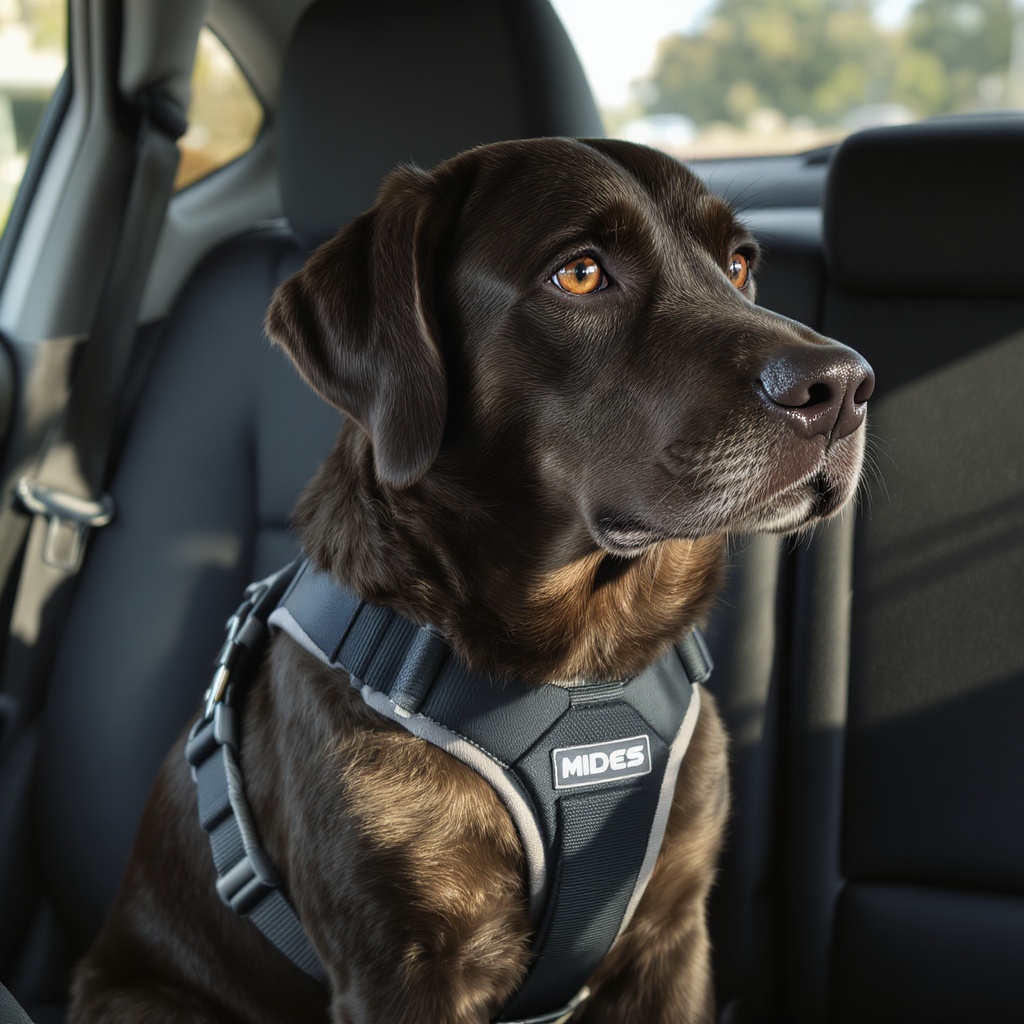
Most "crash-tested" dog car harnesses fail actual crash tests. That's not a marketing claim — it's the documented finding of the Center for Pet Safety (CPS), a non-profit consumer advocacy organization. In their 2013 study funded by Subaru, 11 popular harnesses were tested; only one earned sufficient protection ratings. A regular walking harness is not a car harness, and mixing the two is how dogs become projectiles in a 30-mph crash. This guide covers what CPS certification actually means, how to size a harness by chest girth, and what to buy.
The CPS Crash Test — What Actually Happened
In 2013, the Center for Pet Safety partnered with Subaru and contracted MGA Research Corporation — a lab that had worked with NHTSA on human restraint testing — to conduct the first independent, third-party crash testing of pet travel harnesses.
The protocol tested 11 harnesses across three simulated dog sizes: 25 lb, 45 lb, and 75 lb. Each harness was secured to a crash test dummy and subjected to a 30-mph frontal impact using the same instrumentation standards applied to child safety seats.
The results were sobering. Webbing tore. Hardware deformed. Harnesses failed at forces far below what a real crash generates. Only one product — the Sleepypod Clickit — earned five-star protection ratings across all three size categories. The full test footage is available on CPS's YouTube channel. It's not comfortable viewing, but it's the footage that prompted the existence of the CPS certification standard.
The important context: the study was conducted in 2013. Products have been reformulated since. Some products that failed in 2013 have since passed re-testing. This is why CPS maintains a current certified products list — it changes as products are retested and new data emerges.
What CPS Certification Actually Requires
CPS certification is not a one-size-passes test. The standard requires that all size variants of a product pass the full test protocol. A harness that earns five stars in the small size but fails in the large size does not receive certification — the entire product line fails. This matters because crash dynamics change at different weights and geometries.
The key performance metric is canine excursion — how far the dog's head travels forward in a crash from the moment of impact. The CPS limit is less than 32" for sizes XS through M, and less than 36" for sizes L and XL. Harness hardware and webbing must not deform to the point where the restraint geometry changes during impact.
One more important constraint: zipline-style add-ons and extension tethers disqualify certification. These products, which attach the harness to a long tether running along the car's seatbelt track, were found to increase injury risk in crash tests. The additional slack they introduce allows more forward excursion, not less. They are not compatible with CPS certification and should not be used regardless of marketing claims about "freedom" or "comfort."
What Makes a Dog Car Harness Different from a Walking Harness
A walking harness and a car safety harness are fundamentally different products designed for different failure modes.
A walking harness attaches to a single D-ring at the dog's chest or back. In a car crash, that D-ring becomes a point loading — all the force of a 30-mph impact concentrated on a single clip. Standard walking harness buckles and webbing are not rated for this load. In testing, the D-ring attachment point fails first, and the dog becomes a projectile.
A car safety harness uses a three-point seatbelt attachment: the seatbelt webbing passes through two loops on the harness (above the dog's shoulders on each side), then clicks into the seatbelt receptacle. This distributes crash force across the chest and torso rather than concentrating it at a single point. The design also prevents the dog from pitching forward and hitting the seat or dashboard.
The webbing itself is different. Automotive-grade seatbelt webbing is engineered to absorb and distribute energy — it's the same material used in human seatbelts. Standard nylon webbing used in walking harnesses has different failure characteristics: it tears rather than distributes, and it elongates under load in ways that increase rather than reduce excursion.
A car harness is designed for car use only. Most have no front clip for pulling — the chest-piece vest design distributes force across the body in a way that would cause discomfort if used for walking. Don't attach a leash to a car harness.
Anchor Types — Seatbelt vs LATCH
There are two attachment systems for securing a dog car harness in a vehicle:
Standard seatbelt is the most widely compatible option. The seatbelt webbing passes through the two loops on the back of the harness (above the dog's shoulders) and clicks into the vehicle's seatbelt receptacle. This works in any vehicle with a functional seatbelt system.
LATCH (Lower Anchors for the Conservation of Children) is a system built into some vehicles for child safety seats. Some harnesses are compatible with LATCH anchors. LATCH provides a rigid attachment point that can reduce forward excursion slightly. However, LATCH has lower force limits than seatbelt systems — if a harness is only rated for LATCH attachment, check whether it's been certified with LATCH or whether the certification was only for seatbelt attachment.
Never use a standard walking harness leash clip as a car attachment point. The clip is not rated for crash loads and will fail.
Sizing by Chest Girth
The critical measurement for harness fit is chest girth — the circumference around the widest part of the chest, measured behind the front legs and over the withers (shoulder ridge). This is not the same as neck circumference, which walking harnesses often use as the primary size indicator.
| Harness Size | Chest Girth | Dog Weight |
|---|---|---|
| XS | 13–16 in | 6–15 lbs |
| S | 16–20 in | 15–30 lbs |
| M | 20–26 in | 30–55 lbs |
| L | 26–34 in | 55–85 lbs |
| XL | 34–40 in | 85–120 lbs |
Measure with a fabric tape measure (or a piece of string you then measure) while the dog is standing. The tape should be snug — you want the harness to be fitted, not loose — but not tight enough to restrict breathing. You should be able to fit two fingers between the tape and the dog's chest.
If the measurement falls between two sizes, size up. A slightly loose harness is safer than a tight one that restricts breathing. A harness that's too tight can cause discomfort and panic in a dog who isn't used to being restrained.
What to Buy — CPS-Certified Options
The products below had active CPS certification as of 2025. Check the CPS certified products list before purchasing — certification status changes as products are retested.
Sleepypod Clickit Sport
Full 5-star CPS certified across all size variants. Ballistic nylon exterior, energy-absorbing vest design, seatbelt + LATCH compatible. Available in XS through XL (6–120 lbs). The benchmark product.
Sleepypod Clickit Terrain
Same 5-star CPS certification as the Sport, with more rugged exterior material for active dogs. Higher price for the more durable shell. Same safety performance as the Sport.
CPS-reviewed but not fully certified as of latest data: Kurgo Tru-Fit Enhanced (~$60) meets child car seat standards and was crash-tested at up to 75 lbs — it did not pass the full CPS protocol at all sizes as of the most recent testing. Ezydog Drive (~$80) is FMVSS 213 compliant and vehicle-tested but not on the current CPS certified list.
Fetra Padded Travel Safety Harness
Crash-tested steel hardware, front + back D-rings for dual use (car + walks), fits 15–120 lbs. Energy-absorbing vest design distributes crash force across chest and torso.