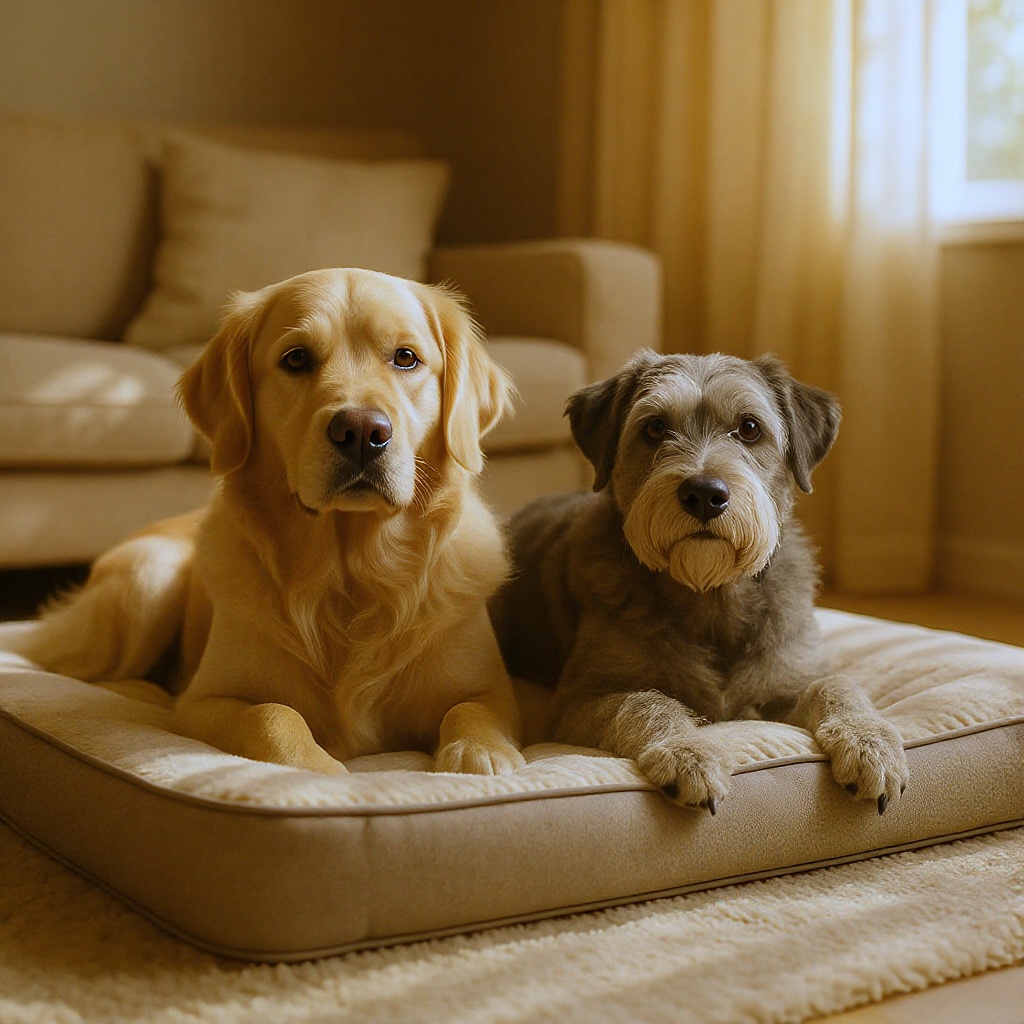
60% of dogs show signs of arthritis by age 10. The bed they sleep on for 12–16 hours a day is one of the biggest controllable factors in joint health. Cheap egg-crate foam flattens in weeks. A real orthopedic bed with high-density memory foam doesn't. This guide covers what actually matters — foam density, size-by-weight fit, washability, and what the word "orthopedic" does and doesn't guarantee.
Why Memory Foam Works for Senior Dogs
Memory foam's value for senior dogs comes from pressure redistribution. Unlike polyester fill that compresses uniformly, memory foam conforms to the dog's body shape — spreading weight across the full contact surface rather than concentrating it on bony prominences like hip sockets and elbows.
The key spec is foam density, measured in pounds per cubic foot (lb/ft³). Quality memory foam for pet applications starts at 1.5 lb/ft³. At that density, the foam resists compression set — it returns to its original shape after each use rather than permanently flattening. Cheaper foam at 0.8–1.0 lb/ft³ loses structural integrity within 3–6 months of daily use by a heavy dog.
Minimum thickness matters too: 3–4" for dogs under 60 lbs, 4"+ for dogs over 60 lbs. But thickness without density is theater — a 4" layer of low-density foam collapses the same way a 2" layer does, just slower.
Open-cell memory foam is more breathable than closed-cell variants, reducing heat retention. Some warmth is unavoidable compared to raised cot-style beds, but for senior dogs who need joint pressure relief, the trade-off favors memory foam over cooling mats unless the dog runs hot year-round.
Size Guide: Picking the Right Dimensions
A bed that's too small forces a senior dog to curl up or sleep on hard floor. When in doubt, go one size up. Dogs often choose to stretch out on a properly sized bed that they wouldn't use if it's cramped.
| Size | Dimensions | Dog Weight | Breed Examples |
|---|---|---|---|
| S | 24 × 18 in | 10–25 lbs | Beagle, Cocker Spaniel, French Bulldog |
| M | 30 × 22 in | 25–50 lbs | Border Collie, Bulldog, Whippet |
| L | 36 × 28 in | 50–80 lbs | Labrador, Golden Retriever, Husky |
| XL ← go up if unsure | 44 × 34 in | 80–130 lbs | German Shepherd, Rottweiler, Great Dane |
Measure your dog from nose to tail base, then add 6–12 inches. The bed should be long enough for them to fully stretch. Width matters equally — a dog that sleeps curled up still needs enough room to uncurl their joints without compression.
Washability and Lifespan
A bed that can't be thoroughly cleaned becomes a bacterial reservoir. For senior dogs with incontinence or joint pain that makes repositioning difficult, this is especially important.
Full perimeter zipper is the minimum acceptable cover design. Partial zippers — which only open one end — don't let you remove the entire cover, leaving sections you can't reach. Check that the zipper goes around all four sides, not just the top.
Machine wash temperature: 60°C (140°F) is the threshold for killing dust mites and most bacteria. Check whether the cover specifies this — some "machine washable" covers are only rated for 30–40°C, which isn't enough.
Waterproof inner liner protects the foam from urine and moisture. Memory foam that gets wet takes days to dry fully and will develop mold or odor within weeks. Even if your dog is house-trained, senior dogs with joint pain often have accidents they can't prevent. A sewn-in liner is harder to check; look for a separate zip-out waterproof layer.
Foam lifespan: quality high-density memory foam maintains structural integrity for 3–5 years under daily use. Cheap foam compresses to half its original height within 6 months. Look at warranty terms — 2 years or more on the foam core is a reasonable signal of density quality. One year or less suggests the manufacturer expects compression.
What to Avoid
Egg-crate foam (cheap variant): The peaks compress faster than the valleys, creating uneven pressure distribution. What looks like "extra cushioning" is actually a surface that concentrates weight on narrow contact points. A senior dog with hip dysplasia gets less support from egg-crate than from a flat foam surface of the same total thickness.
Poly-fill under a thin memory foam cap: Some beds market themselves as "orthopedic" by placing a 0.5–1" layer of actual memory foam on top of several inches of polyester fill. The poly-fill provides no joint support and compresses immediately. You feel the memory foam when you press the surface; you get the poly-fill's "sinking" when a 60+ lb dog lies on it for a night.
Non-removable covers: Spot-cleaning cannot reach urine, drool, and hair that work their way into the base fabric. Over time, the bed develops odor that won't wash out — at that point the entire bed needs replacement.
No non-slip base: On hardwood or tile, a smooth-bottomed bed slides under the dog's weight. The dog wakes up with the bed bunched against a wall and themselves on the floor. A rubberized non-slip base keeps the bed in place.
Fetra Orthopedic Memory Foam Bed
Open-cell memory foam (1.5+ lb/ft³), full-perimeter zipper cover, machine-washable at 60°C, waterproof liner, non-slip base. No egg-crate, no poly-fill cap.